
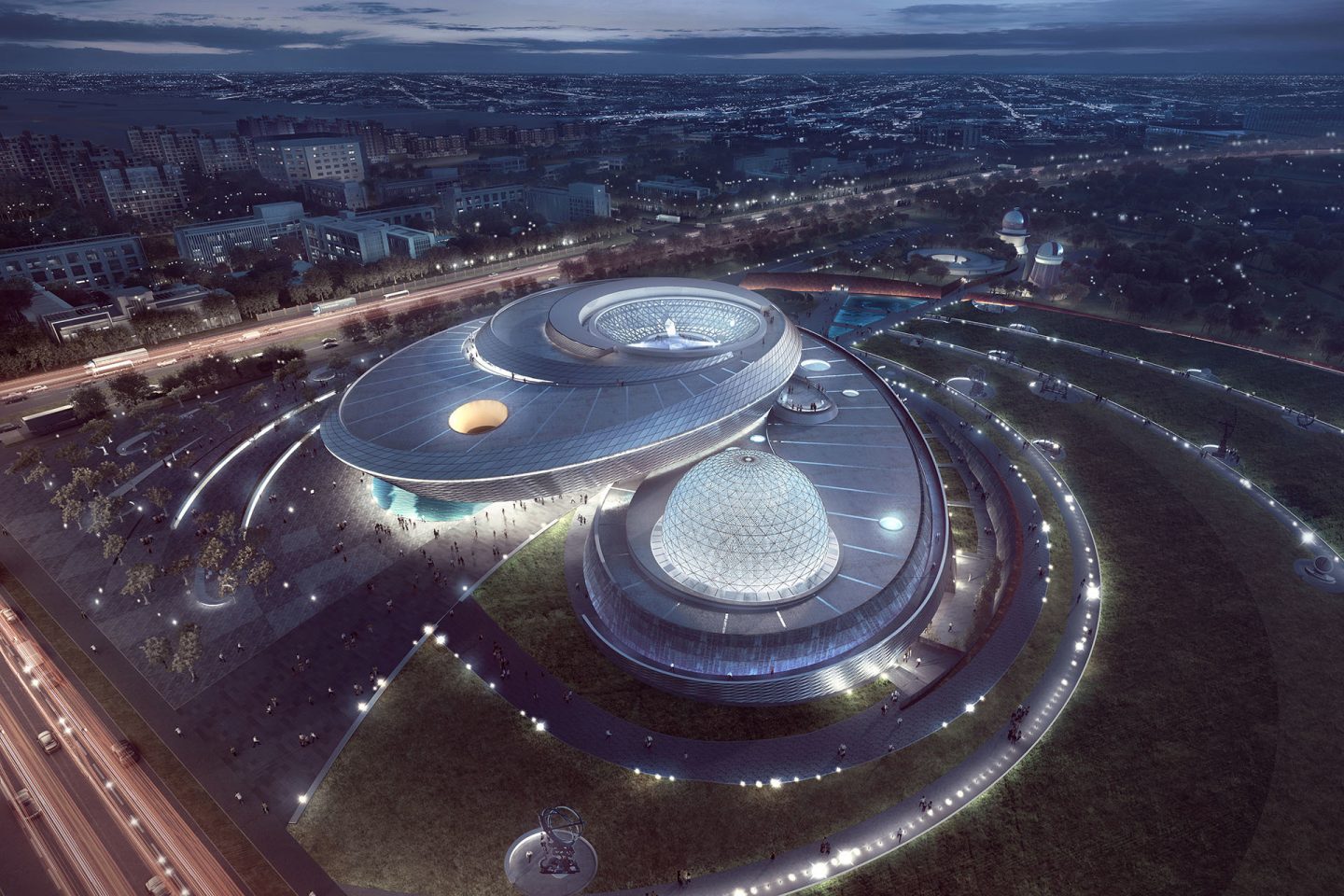
courtesy of Ennead Architects
Astronomy and the planets and solar systems within it, are a source of wonderment and awe for many people. Planetariums, which are educational facilities for the hands-on and interactive learning about astronomy, can be found across the world. China is currently building a pretty spectacular planetarium in Shanghai, the country’s biggest city.
When completed in 2020, the Shanghai Planetarium will cover 420,000 gross square feet and will feature a 68 foot diameter digital sky theater, a 60 foot diameter optical planetarium, an IMAX theater, and more. According to Shanghai Daily, the impressive looking structure will cost around $81 million.
Almost every planetarium in the world incorporates a large sphere into the design and construction, and this one is no different, although it does also feature an inverted dome, as well. The design elements were inspired by “astronomical principles” and “invokes the experience of orbital motion” according to the website of the designer, Ennead.
The drone footage below gives a glimpse into the construction process of the planetarium. There is a steel ring truss that supports the 115 foot cantilever and steel sphere where the planetarium theater will be, according to Designboom. I have to admit, it’s always a bit jarring to me to still see bamboo scaffolding.
Check out the video below of the planetarium’s construction progress so far:








While still new in the construction industries, robots are typically designed to perform a specific task in a highly precise and efficient way, like the rebar tying robot, Tybot or the brick-laying robot Hadrian X. More recently, though, robots are being imagined as platforms for 3rd party companies to develop hardware and accessories to attach to the base robot, like the Boston Dynamics robotic dog, Spot. I recently came across a new robot, called Baubot, which hopes to one day perform tasks using every tool on a typical jobsite.